The Prepress Guide to QR Code Print Sizing: From Business Cards to Billboards
A practical engineering guide for prepress operators and graphic designers. Calculate exact physical millimeter dimensions, minimum module widths, and viewing distance ratios for commercial print collateral.
Key Takeaways
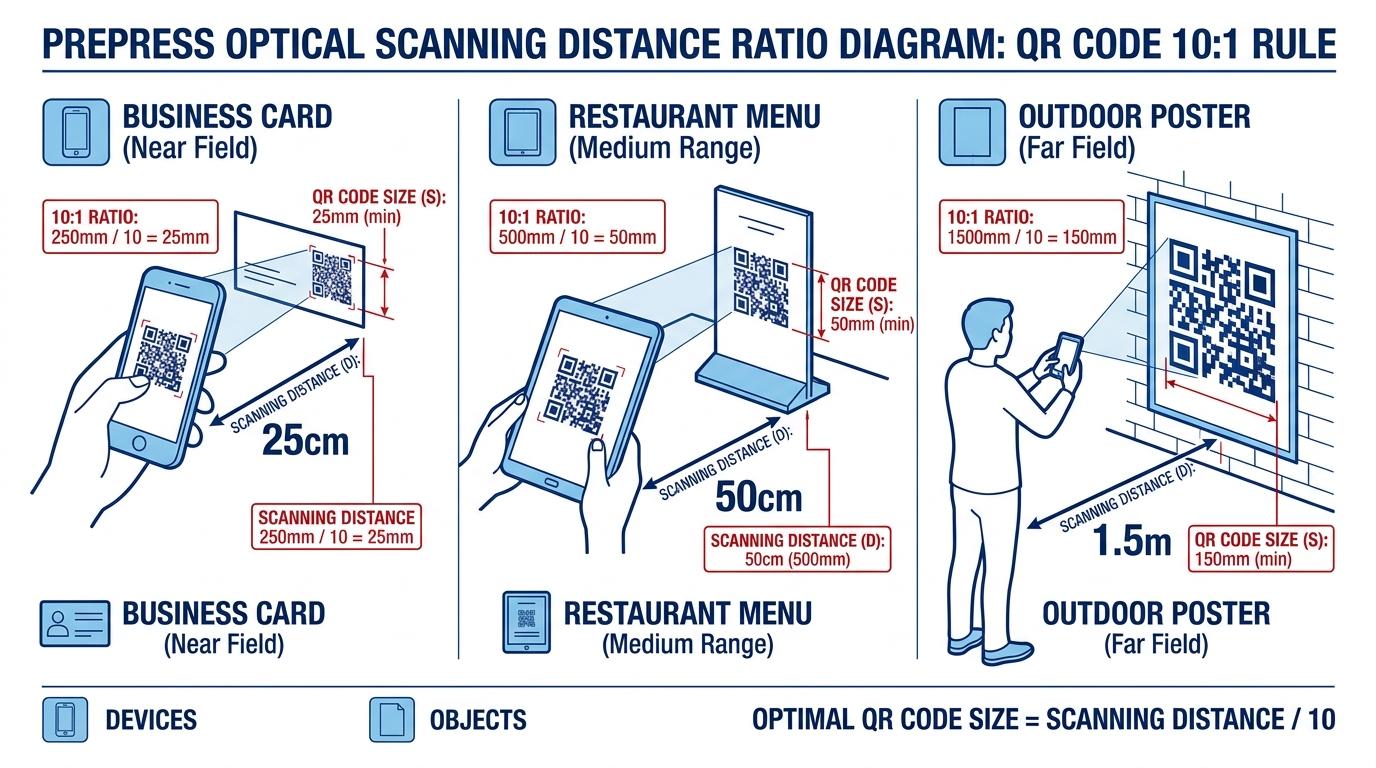
- The optical 10:1 distance rule states that QR code width must equal at least 1/10th of the physical scanning distance.
- Handheld print collateral (business cards, flyers) requires an absolute safe minimum of 20 mm × 20 mm, with 25 mm recommended.
- Each individual module in physical print must measure at least 0.50 mm wide to prevent commercial printing press dot gain from bridging modules.
- Wall posters and window graphics scanned from 1.0 to 1.5 meters require codes sized between 80 mm and 120 mm.
- Trade show pull-up banners scanned across exhibition aisles (2.5 to 3.5 meters) require large-format codes measuring 250 mm to 350 mm.
The Optical Physics Behind the 10:1 Scanning Distance Ratio
The human eye and smartphone camera sensors operate under identical laws of optical perspective: as the physical distance between the camera sensor and an object doubles, the object angular subtended size on the image sensor is halved.
Through extensive empirical testing across flagship and budget mobile hardware, pre-press engineers established the 10:1 Scanning Distance Rule. This formula dictates that the physical width of a QR code should be at least one-tenth of the intended scanning distance:
Minimum QR Width = Scanning Distance / 10
For example, if an attendee scans a trade show backdrop from 2.5 meters (2,500 mm) away, the code should measure at least 250 mm × 250 mm. If a seated diner scans a tabletop menu stand from 45 cm (450 mm) away, the code should measure 45 mm × 45 mm. Adhering to this ratio ensures the QR code projects a sufficiently large image onto the camera CMOS sensor to resolve individual modules without requiring digital zoom.
Calculating Minimum Physical Dimensions Across Mediums
Applying the 10:1 ratio across standard commercial print mediums yields proven sizing benchmarks that guarantee reliable scanning across all smartphone hardware:
1. Business Cards (200 mm reading distance): Recommended 22 mm to 25 mm (20 mm absolute safe floor).
2. Tabletop Restaurant Menus (400 mm reading distance): Recommended 35 mm to 45 mm.
3. Marketing Flyers & Postcards (350 mm reading distance): Recommended 25 mm to 35 mm.
4. Wall Posters & Bulletin Boards (1,200 mm reading distance): Recommended 80 mm to 120 mm.
5. Trade Show Banners & Backdrops (2,500 mm reading distance): Recommended 200 mm to 350 mm.
6. Product Packaging & Bottles (180 mm reading distance): Recommended 18 mm to 22 mm (15 mm flat carton floor).
Module Resolution, Grid Versions, and Prepress Dot Gain
A QR code is composed of an N×N grid of square modules. The grid size is governed by the QR Version (Version 1 has 21×21 modules; Version 10 has 57×57 modules; Version 40 has 177×177 modules). The version number increases automatically with payload character length and error correction level.
To calculate the physical size of a single module on paper, divide the total QR code width by the number of modules across the grid:
Module Width = Total Width / Module Count
In commercial printing (offset lithography, flexography, and digital web), individual ink dots expand as wet ink absorbs into paper fibers—a physical phenomenon known as dot gain. If a single module is smaller than 0.50 mm (0.02 inches), dot gain can cause dark modules to expand into white spaces, corrupting the optical bitstream. Pre-press designers should ensure that individual module widths never fall below 0.50 mm.
Paper Stocks, Matte Lamination, and Environmental Lighting
Paper stock selection directly influences barcode scannability. Uncoated and recycled stocks suffer higher dot gain than coated stocks. When printing on absorbent uncoated paper, increase the code dimensions by 10% to 15% to compensate for ink feathering.
Surface finish is equally critical. High-gloss UV coatings, gloss film lamination, and shiny metallic foils create intense specular reflections under overhead downlights or spotlights. These hot spots blind camera sensors and wash out contrast.
Always specify matte, satin, or soft-touch finishes for printed items bearing QR codes. A matte surface diffuses ambient light evenly, preserving maximum module contrast from all viewing angles.
Prepress Checklist: Vector Export, DPI Targets, and Press Proofing
Before sending marketing collateral to commercial press production, verify the following pre-press checklist:
1. File Format: Supplied in vector SVG, EPS, or PDF to preserve mathematical sharpness.
2. Resolution: If raster files must be used, ensure minimum 300 DPI at 100% final physical print dimensions (600 DPI for packaging labels).
3. Quiet Zone: Verified minimum 4 modules of clean, unprinted border surrounding all four sides.
4. Contrast: Dark modules (preferably pure 100% Black) on a white backing container with at least 7:1 contrast ratio.
5. Physical Proofing: Request a hard-copy digital press proof. Test scan the proof under dim lighting using both an iPhone and an entry-level Android smartphone.
Reference Table: Sizing Recommendations from Business Cards to Banners
Handheld cards (20–25 cm distance): 22–25 mm width | Version 1–5 grid | Level M error correction | Silk/Matte cardstock.
Table acrylics (35–50 cm distance): 35–45 mm width | Version 1–4 grid | Level Q error correction | Matte lamination.
Flyers and mailers (30–40 cm distance): 25–35 mm width | Version 1–4 grid | Level M error correction | Coated silk paper.
Wall posters (1.0–1.5 m distance): 80–120 mm width | Version 2–6 grid | Level Q error correction | Matte poster paper.
Trade show banners (2.5–3.5 m distance): 200–350 mm width | Version 2–6 grid | Level H error correction | Blockout matte vinyl.
Product packaging (15–20 cm distance): 18–22 mm width | Version 1–3 grid | Level M/Q error correction | Coated label stock.
Ready to generate a permanent static QR code?
Create direct static codes with instant client-side decode verification and infinite-resolution vector SVG downloads.